Sega Mega Drive
Sega’s 16-bit cartridge-based game console, distinguished by an 8MHz 68000 CPU and dual playfield video architecture, achieved market prominence with Sonic the Hedgehog and a technically precise arcade port library.
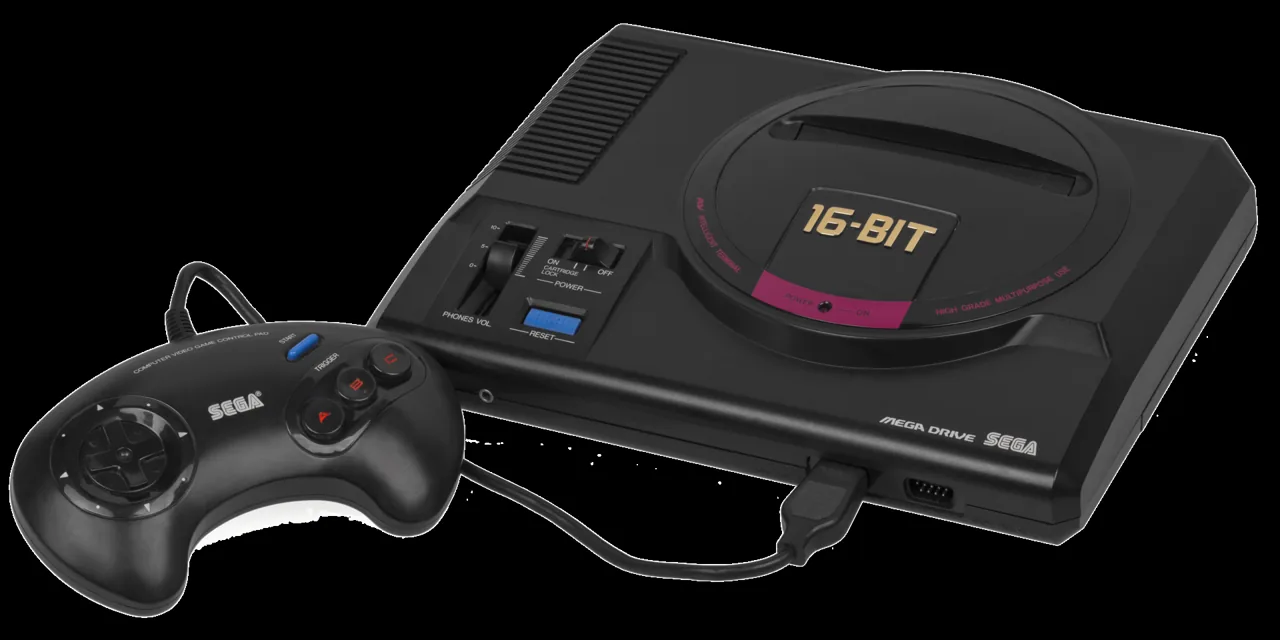
Sega positioned the Mega Drive as a high-performance alternative to its 16-bit contemporaries, leveraging an architecture that offloaded video tasks from the main CPU7. Central to its design was an 8MHz Motorola 68000 processor paired with 64K of processor RAM and 64K of video RAM7. Unlike systems such as the Amiga or Atari ST, the CPU did not have direct access to the screen buffer, a design choice reflecting arcade engineering practices7. The video subsystem featured a sprite engine capable of managing up to 128 sprites per frame, with a limit of 32 per scanline, and supported two independently scrolled playfields to enable parallax scrolling effects7. Sound processing was delegated to a dedicated Z80A CPU, a configuration described as devoting as much processing power to audio as an entire ZX Spectrum7.
The console’s performance edge was attributed to its support video circuitry, which relieved the main processor of intensive graphical tasks, allowing it to focus on game logic7. This architecture made the Mega Drive particularly adept at replicating arcade titles, with games like Shinobi, Super Hang On, Thunderforce 2, and Darius 2 showcasing its capabilities3. Later titles such as Shining Force, Eternal Champions, Landstalker, and Mortal Kombat further demonstrated its longevity and technical reach611. Sonic the Hedgehog became its defining release4.
Sega expanded the platform with peripherals, including the Mega-CD, a CD-ROM add-on that incorporated its own 68000 CPU and additional RAM78. This move followed a trajectory similar to NEC’s and Amiga’s CDTV initiative7. The Mega-CD introduced higher-capacity media but faced limitations: the MEGA CD-R, for instance, could not perform quadruple-speed write operations15. A specific variant, the blue-labeled Sega MEGA CD-R disc, operated at 1.25 m/s and bore the official Sega logo15.
Hardware revisions included the Mega Drive 2, described as Sega’s revised hardware design and sold both as a standalone unit (209 DM) and bundled with games such as Aladdin (299 DM) or three titles (279 DM)111. Despite the update, the revised model commanded roughly the same collector price as a well-preserved original in box1. The Hong Kong Mega Drive, identifiable by its gold label, gained collector status for its region-free compatibility: it played Japanese, UK, and US Genesis games on a UK television without modification1. Its desirability remains high, with Japanese (non-Asian) models also maintaining strong resale value1.
Third-party tools such as the Master Convertor and Action Replay were available13. Tengen released software for the platform, though documentation notes these titles were limited in scope1. A 50/60 Hz modification was available for the Mega Drive6. The Psy-Q development system listed the SEGA MegaDrive/Genesis as a supported platform, indicating professional-grade tooling availability16.
Sega’s internal roadmap included more ambitious projects. The 32X, codenamed “Mars,” was a separate add-on initiative distinct from the unreleased cartridge-based 32-bit console known as Jupiter2. The Jupiter, often confused with the 32X, reportedly shared specifications with the Sega Saturn and could theoretically be upgraded to Saturn functionality with an external CD drive, mirroring the Mega Drive–Mega-CD relationship2. EDGE magazine speculated it would have retailed for ¥30,000, significantly below the Saturn’s ¥50,000 launch price2.
At retail, the Mega Drive appeared in bundles such as the $129 package including a power adapter, joystick, TV or SCART cable, and a Mickey Mouse game14. European pricing varied: a PAL console with one game was listed at 399 (likely DM)10, while a bundle with Sonic carried a 389.00 DM price tag13. Individual game prices in the UK ranged from £44.99 to £59.99, as seen in contemporary listings4.
The console’s legacy rests on its architectural confidence and aggressive software curation. While it lacked built-in region locking in certain variants and supported a technically sophisticated pipeline for arcade ports, its documentation reveals no unified OS, I/O specifications, or physical dimensions, gaps that persist in the archival record. What remains clear is its presence in the secondhand market: the Mega Drive “occupies many a cash converter’s shelves,” though complete boxed units require more effort to source1.
Specifications
| Processor | 8MHz 68000 |
| Processor RAM | 64K |
| Video RAM | 64K |
| Sound Processor | Z80A |
| Video Features | Up to 128 sprites, 32 per line; two playfields for parallax scrolling |
| Architecture | Traditional arcade-style video design; CPU lacks direct screen access |
| Classification | 16-bit game console |
References
- EDGE.RETRO.N3.2003.Guide.collecting-DURiAN (2003)
- Sega Saturn Encyclopedia vol2
- Power.Play.N36.1991.03-kultpower (1991)
- Computer and Video Games Issue 146 1994-01 EMAP Images GB (1994)
- Video Games 1993-05 (1993)
- Video Games 1993-12 (1993)
- The One (1991-02) (1991)
- The One (1991-02) (1991)
- Video Games 1993-05 (1993)
- Power.Play.N038.1991.05-kultpower (1991)
- Video Games 1993-12 (1993)
- Archive item #CVG110199101
- Amiga Joker 1992 05 (1992)
- Archive item #CVG112199103
- Sattechs
- Archive item #7427924