Sega Genesis
Sega’s 16-bit home video game console, launched in the United States in September 1989, established an early lead in the 16-bit console market with hardware derived from arcade systems and a library bolstered by third-party developers.
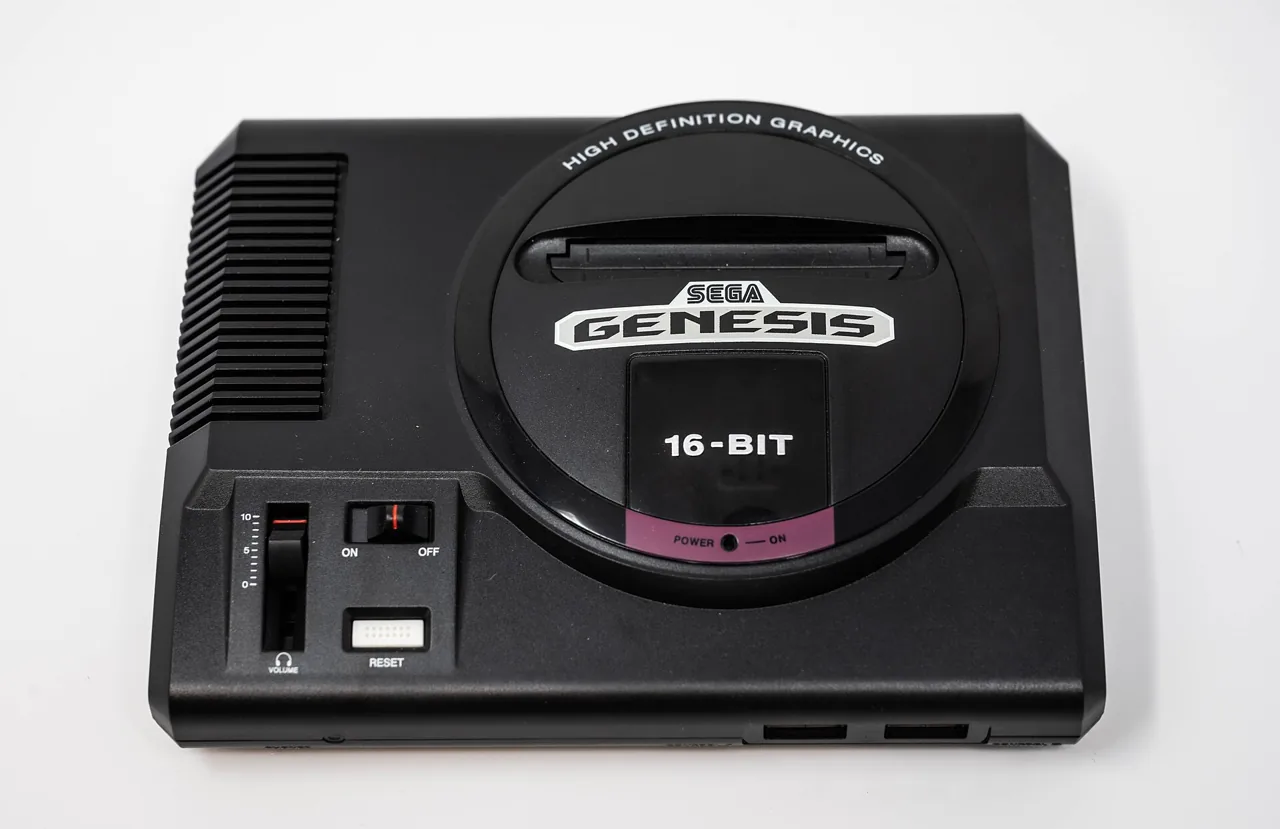
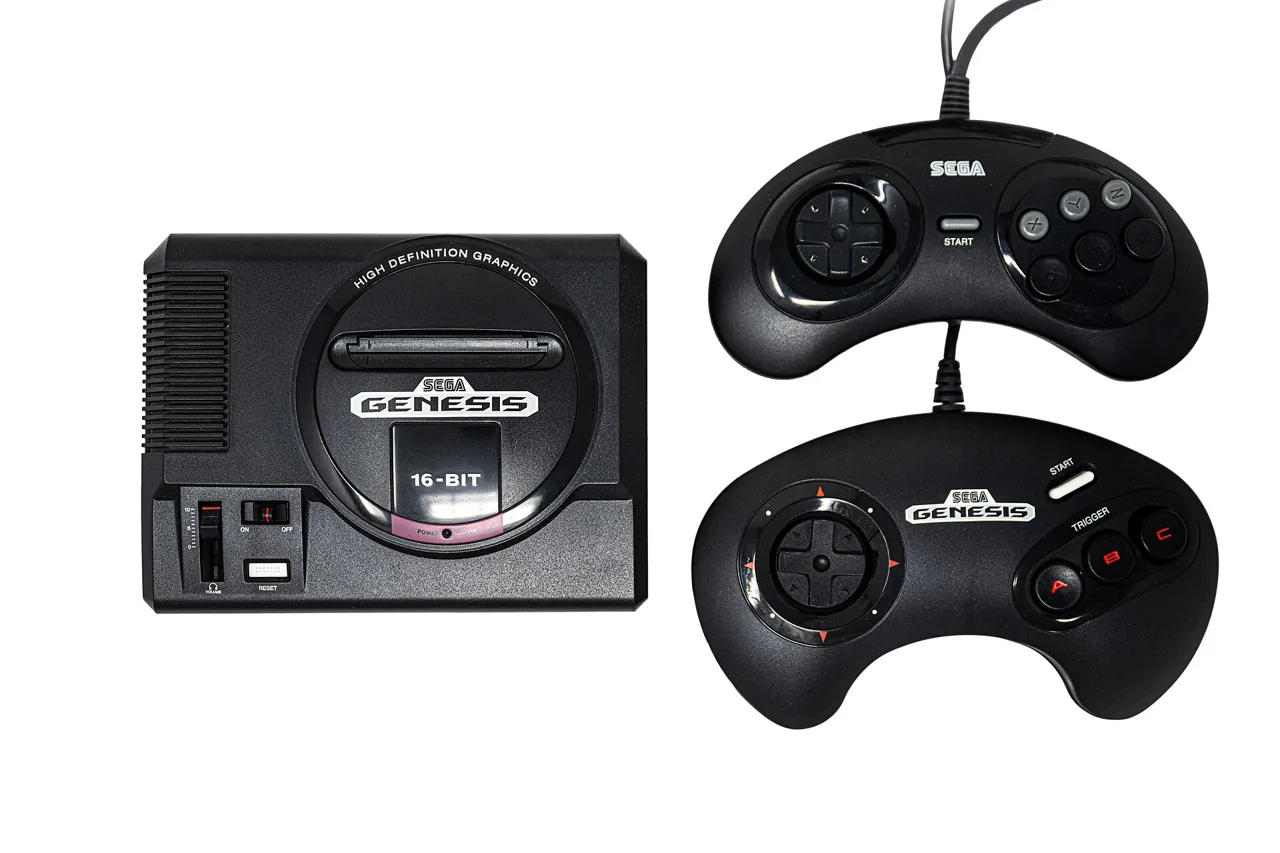
The Genesis shipped in limited quantities to New York and Los Angeles on August 14, with nationwide distribution achieved by September 159. It debuted at a price of $199.99 (£125), though a $10 price reduction was implemented by mid-September9. Market reception was initially strong: Sega was described as “the electronic hit of that holiday” season, capturing the majority of the 16-bit console segment during the tenure of CEO Tom Kalinske63. Despite this, momentum slowed; by 1992, the system was perceived as treading water, dependent on third-party publishers for compelling new software6.
The Genesis featured a 68000 CPU, a microprocessor also used in the Atari ST and common in coin-operated arcade machines of the era11. The exact clock speed is inconsistently documented: one source specifies 7.6MHz5, while others state only “over 7 MHz”815. The system contained 6 Megabit of RAM5 and delivered stereo sound through an 8-channel audio system, with output available via a headphone jack or external amplifier511. It supported high-resolution graphics and could display more than 500 colors on screen, though exact figures vary: sources cite available colors as 5125, with on-screen counts reported as 645. Similarly, maximum sprite count is given as 805, and resolution is listed as 320x2245. The system included a custom graphics chip enabling two independently scrolling playfields and arcade-quality visuals11.
The Genesis featured an 8-pin DIN connector for video and audio output, with pin assignments as follows: Pin 1 (audio), Pin 2 (ground), Pin 3 (video), Pin 4 (+5V), Pin 5 (Green), Pin 6 (Red), Pin 7 (composite H&V sync), Pin 8 (Blue)13. This connector used an unusual pin spacing, making standard 8-pin male DIN plugs incompatible without modification13.
Backward compatibility with Sega’s earlier 8-bit Master System was possible through the Power Base Converter, a peripheral priced at approximately $301. While Master System games could run on the Genesis, the reverse was not possible1. The Japanese counterpart to the Genesis was the Mega Drive, which had CD-ROM capability prior to its North American counterpart6. Sega of America delayed its own CD add-on release until a sufficient software library could be developed6. The Sega CD, Genesis Super 32X, and Sega Channel were all designed to extend the Genesis platform357.
Notable titles available for the Genesis included Golden Axe, ToeJam & Earl, Alien 3, Batman Returns, Out of This World, The Lion King, and Tommy Lasorda Baseball5981516. Despite strong graphics in titles like Fantasia and Taz-Mania, some were criticized for awkward gameplay mechanics6. By 1993, observers noted the lack of hardware or software scaling as a growing disadvantage, particularly in comparison to Nintendo’s Mode 7 technology56.
Hardware revisions included the Genesis3, described as the smallest standard Mega Drive revision9, and the Sega Nomad, a handheld version released in the US9. Other variants documented include the Sega Multi-Mega PAL and the Sega Genesis CDX12.
References
- Winner's Guide to Sega Genesis (1990) (1990)
- Winning Tips for Sega Genesis (1993) (1993)
- Electronic Games 1994-06 (1994)
- vgc03
- Electronic Gaming Monthly's 1993 Video Game Buyer's Guide (1993)
- Electronic Games - 199210 - Volume 1 Issue 3 (1992)
- Electronic-Games-1994-09 (1994)
- Video Games and Computer Entertainment - Issue 40 - May 1992 (1992)
- EDGE.RETRO.N3.2003.Guide.collecting-DURiAN (2003)
- Computer Gaming World - 199302 - Number 103 (1993)
- Analog Computing 79 1989-12 Double Megafile Storage (1989)
- Archive item #6489137
- The Rainbow Vol. 10 No. 02 - September 1990 (1990)
- Electronic Games 1994-08 (1994)
- Video Games and Computer Entertainment - Issue 40 - May 1992 (Compressed) (1992)
- lionkingofficial00rich 1 (Removed Duplicate Pages)